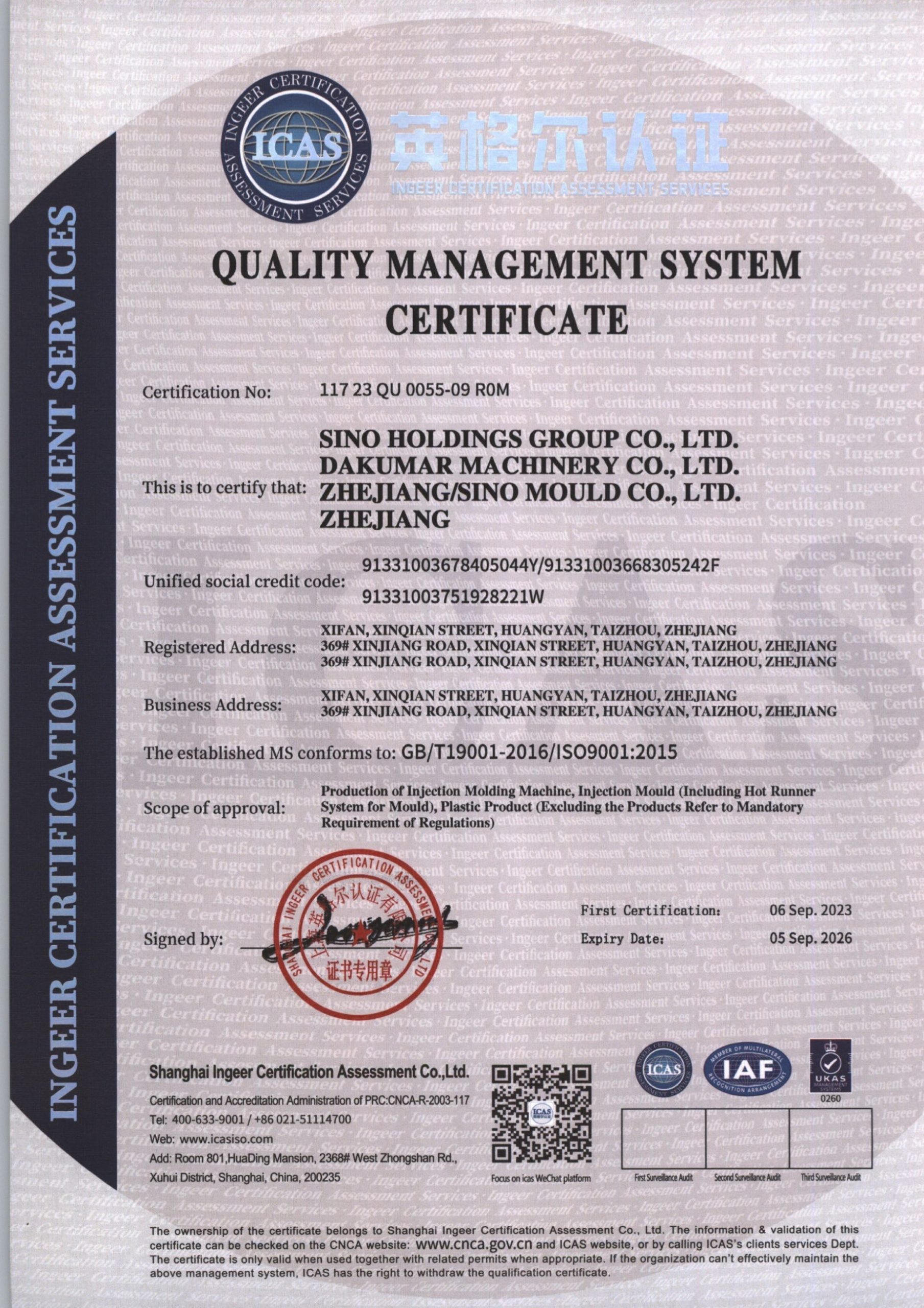
SINOMOULD passed ISO9001 and IATF 16949 Quality Management System certifications.
The China Quality Certification Centre (CQC), as a national-level authoritative certification body approved by the Certification and Accreditation Administration of the People’s Republic of China (CNCA) and accredited by the China National Accreditation Service for Conformity Assessment (CNAS), conducted quality management system certification audits on SINOMOULD in accordance with the ISO 9001:2015 “Quality Management Systems — Requirements” international standard. ISO 9001:2015 is the most widely applied quality management framework globally, issued by the International Organization for Standardization (ISO), with over one million organizations across more than 170 countries and regions now certified. IATF 16949 is a quality management system standard widely recognized in the global automotive industry, jointly developed by the International Automotive Task Force (IATF) and ISO. Based on the ISO 9001 framework with additional automotive industry-specific requirements, it is the “passport” for automotive parts suppliers to enter the global automotive supply chain. The certificate is valid for a maximum of 3 years, and certified enterprises must undergo annual surveillance audits. Zhejiang SINOMOULD Co., Ltd. has passed ISO9001 Quality Management System certification and IATF 16949 Automotive Industry Quality Management System certification, and holds the relevant management system certificates. This signifies that SINOMOULD’s full-process quality management and control capability in mold design, manufacturing, and service has reached internationally recognized standards.
Dual-System Certification Covers Full Process — Quality Management and Control Capability Fully Meets Standards
ISO 9001:2015 adopts a management philosophy combining the “process approach” with the PDCA cycle (Plan-Do-Check-Act), covering seven core modules: context of the organization, leadership, planning, support, operation, performance evaluation, and improvement, emphasizing customer focus, the process approach, and continuous improvement. IATF 16949 adds automotive industry-specific requirements on the ISO 9001 framework, covering key areas such as product safety, embedded software, supplier management, and traceability, and is one of the mandatory qualification standards for automotive parts suppliers. Relying on over 20 years of manufacturing experience in the precision injection mold field, over 40,000 sets of mold delivery track record, and market performance with products sold in over 100 countries worldwide, SINOMOULD fully met the standards in the full-process audits of both system certifications.
The ISO9001 system requires systematic review, verification, and validation during the design and development phase. In mold design, SINOMOULD’s design team uses software such as Pro-E, UG, and AutoCAD to complete 2D and 3D product design and mold design. From mold design to Powermill programming to CNC machining center processing, achieving CNC mold machining from 2-axis to 5-axis, all independently completed by the team, ensuring data accuracy and mold precision, with strict execution of design review and change control procedures throughout this process. In mold manufacturing, the IATF 16949 system imposes strict standards on production process control, requiring identification of key processes and establishment of standardized work instructions. In precision mold manufacturing, SINOMOULD is equipped with 32 to 36 units of advanced processing equipment including CNC milling machines, independently completing the entire process from mold design and programming to machining, strictly implementing standardized process parameter control, and ensuring the consistency and traceability of mold manufacturing quality.
Certification System Covers the Entire Process, Providing Customers with Standardized Quality Assurance
SINOMOULD takes “injection molding system solutions” as its core positioning, with the certification system covering the entire process from mold delivery to injection molding support. In injection molding, by establishing standardized operating procedures and product inspection specifications, it ensures the molding stability and finished product qualification rate of molds on customers’ injection molding production lines.
In quality control systems, SINOMOULD has passed ISO9001 Quality Management System certification and IATF 16949 Automotive Management System certification, establishing a full-process quality control system covering raw material inspection, processing process monitoring, finished product delivery testing, and non-conforming product control, and using the system-required continuous improvement mechanism to drive ongoing product quality enhancement. In 2023 and 2024, its taxpayer credit rating was A-level, and it was recognized as a Zhejiang Province “Contract-Honoring and Credit-Respecting” AAA-Level Enterprise.
Customer Value: Supply Chain Qualification Bonus Points, Reduced Quality Risk
IATF 16949 certification has increasingly become a mandatory check item for supplier qualification by more and more OEMs and large purchasers, serving as the “passport” for entering vehicle manufacturer procurement catalogs. SINOMOULD’s dual-system certification means that the enterprise possesses full-chain standardized quality control capability from mold design review and processing process monitoring to shipment inspection, ensuring that the precision, lifespan, and delivery time of each mold set have traceable process guarantees. When customers choose to cooperate with system-certified suppliers, they can gain bonus points in their own supplier audits and bidding evaluations, reducing supply chain quality risks.
According to IATF 16949 certification management requirements, the certificate is valid for a maximum of 3 years, and certified enterprises must undergo annual surveillance audits. SINOMOULD will continue to hold itself to dual-system standards, ensuring the continuous and effective operation of the quality management and control system.