Blog
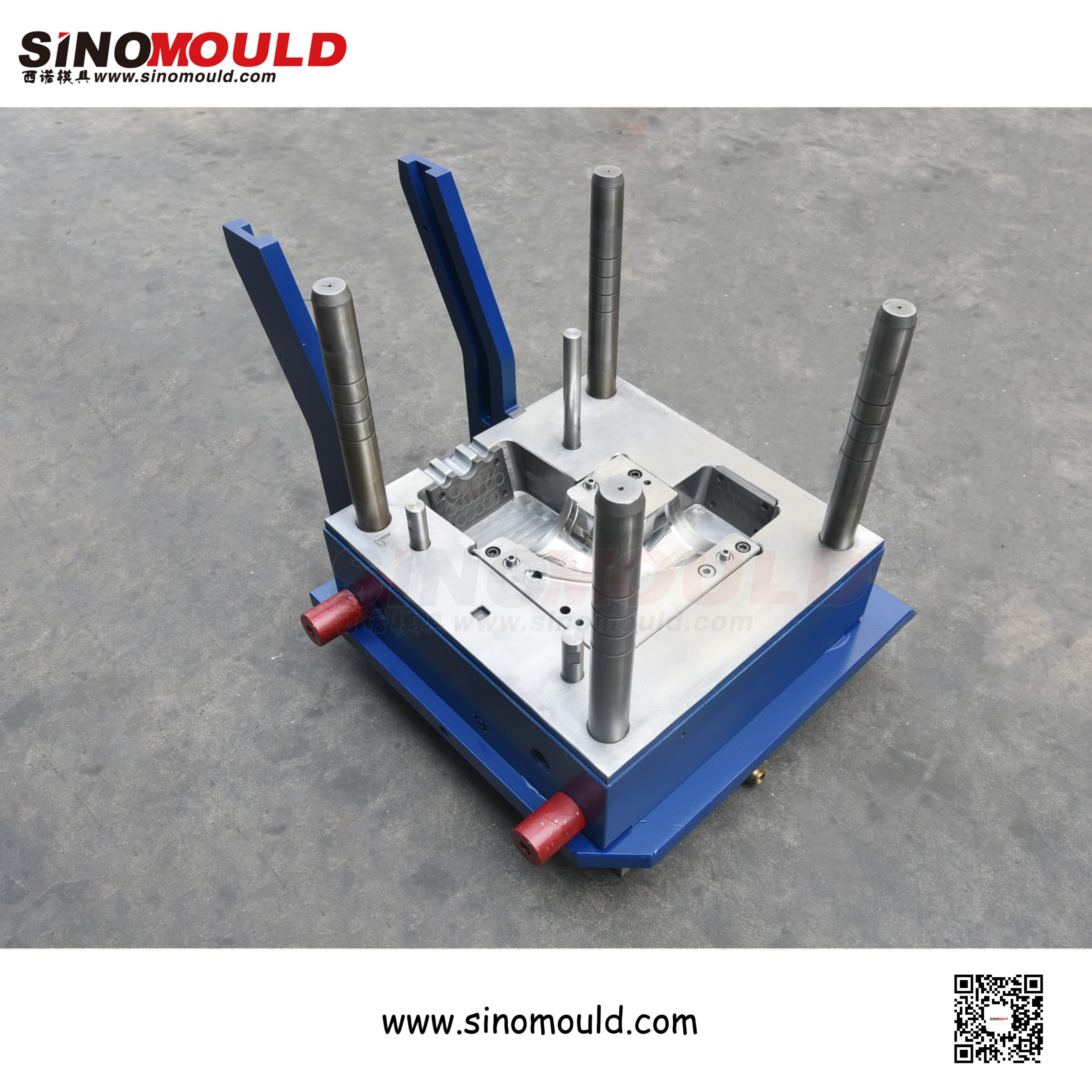
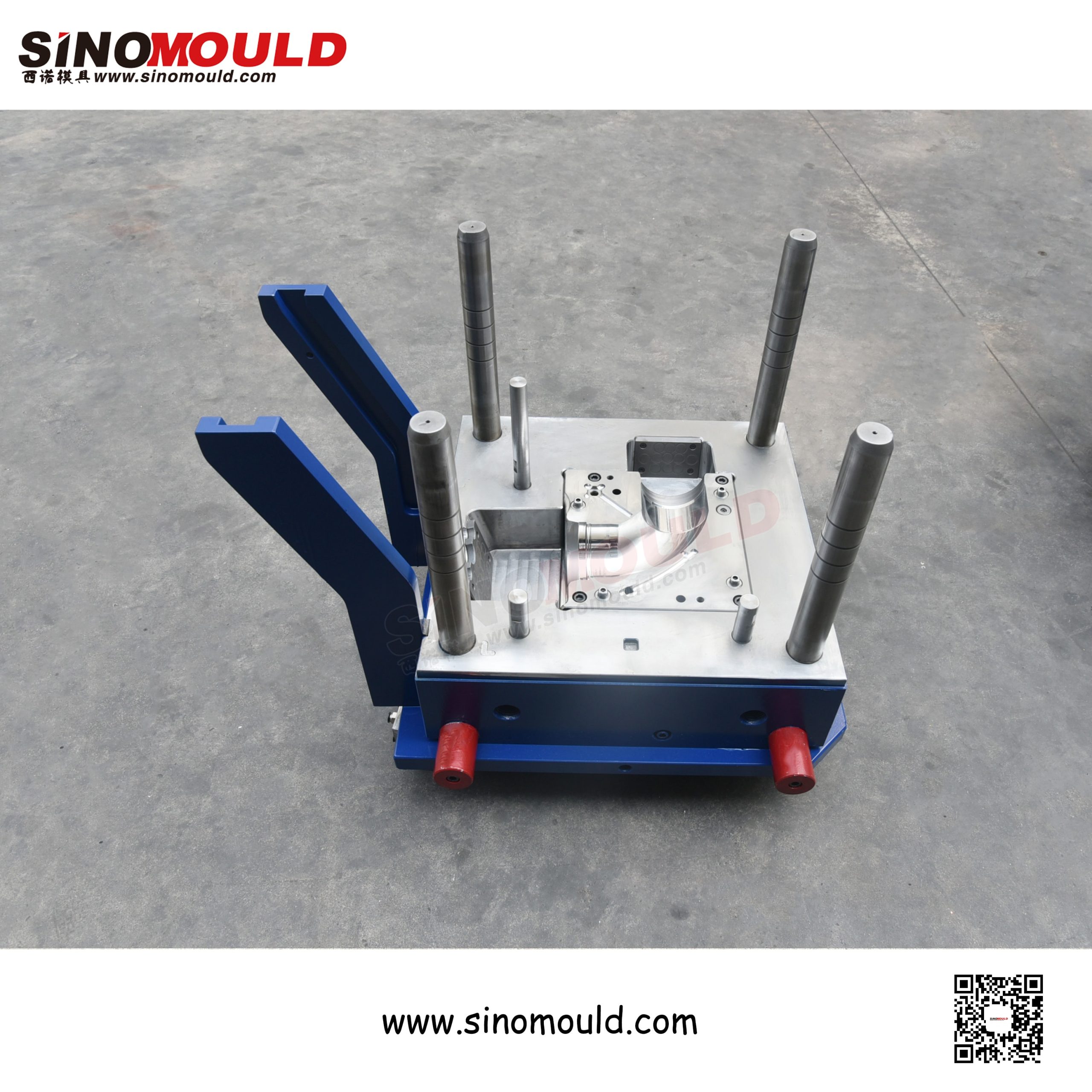
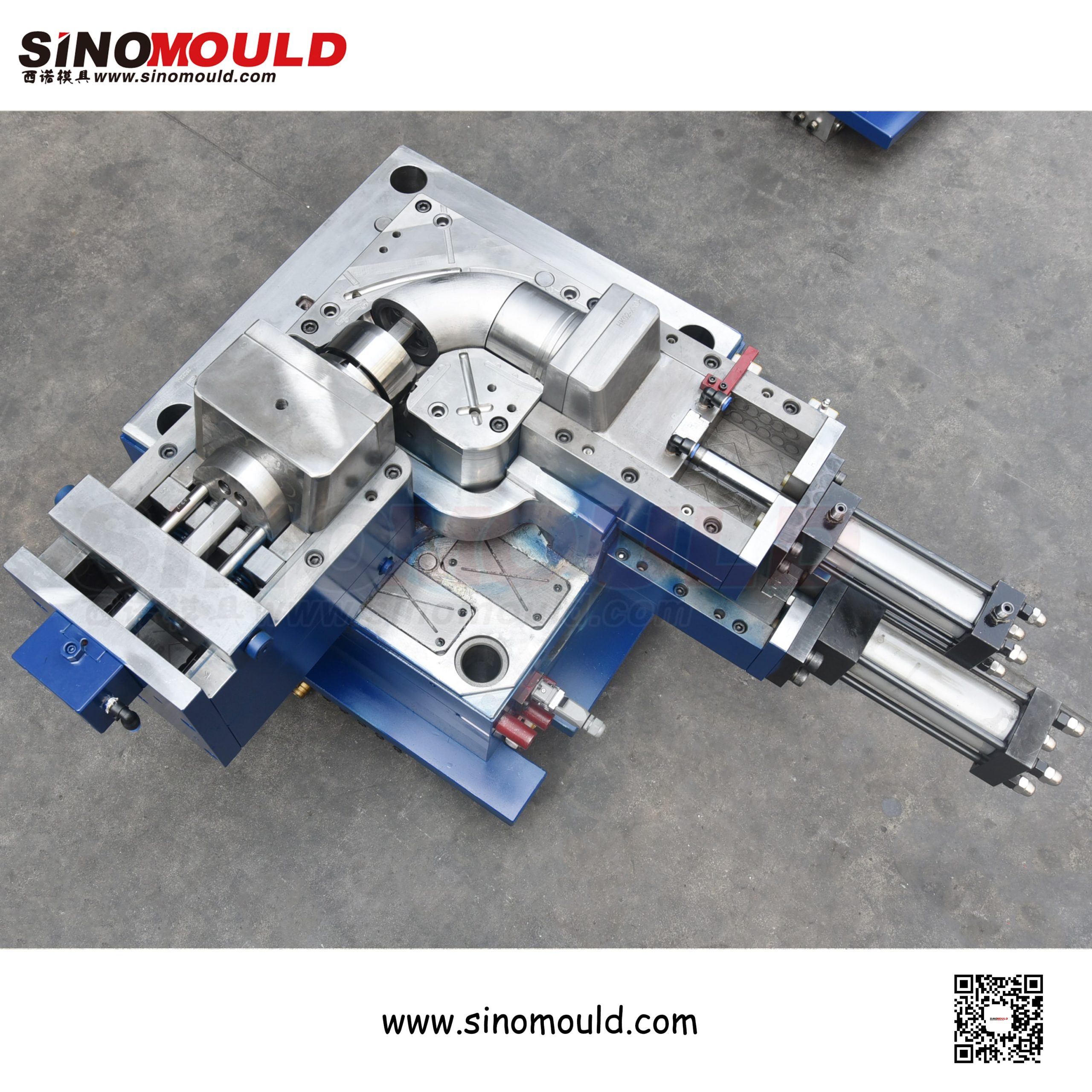
PVC 90° Elbow Pipe Mould
The PVC 90° elbow is the most widely used directional fitting in drainage, sewage, and ventilation piping systems, redirecting flow at a right angle between horizontal and vertical runs. With a 100mm (DN100) nominal diameter, this fitting sits at the boundary between small and large pipe categories: its wall sections are thick enough to demand longer cooling, yet its socket ends must still meet tight dimensional tolerances for solvent-cement or rubber-ring joints. The right-angle geometry creates a further challenge—the internal core must negotiate a full 90° arc during withdrawal, requiring a longer stroke and more precise trajectory control than shallower bends.
At SINOMOULD, we specialise in large-angle core-pulling systems for 90° elbows, combining staged core withdrawal with rigid guide structures to prevent scratching or ovalisation of the bore. The following outlines key specifications, quality priorities, and manufacturing essentials.
PVC 90° Elbow Pipe Mould Parameters
| Mould Cavity Steel | DIN 1.2316, S136 | Recommended Injection Machine | 350T – 800T |
|---|---|---|---|
| Mould Core Steel | DIN 1.2316, S136, P20 | Plastic Material | PVC-U (rigid / lead-free), PP, PE |
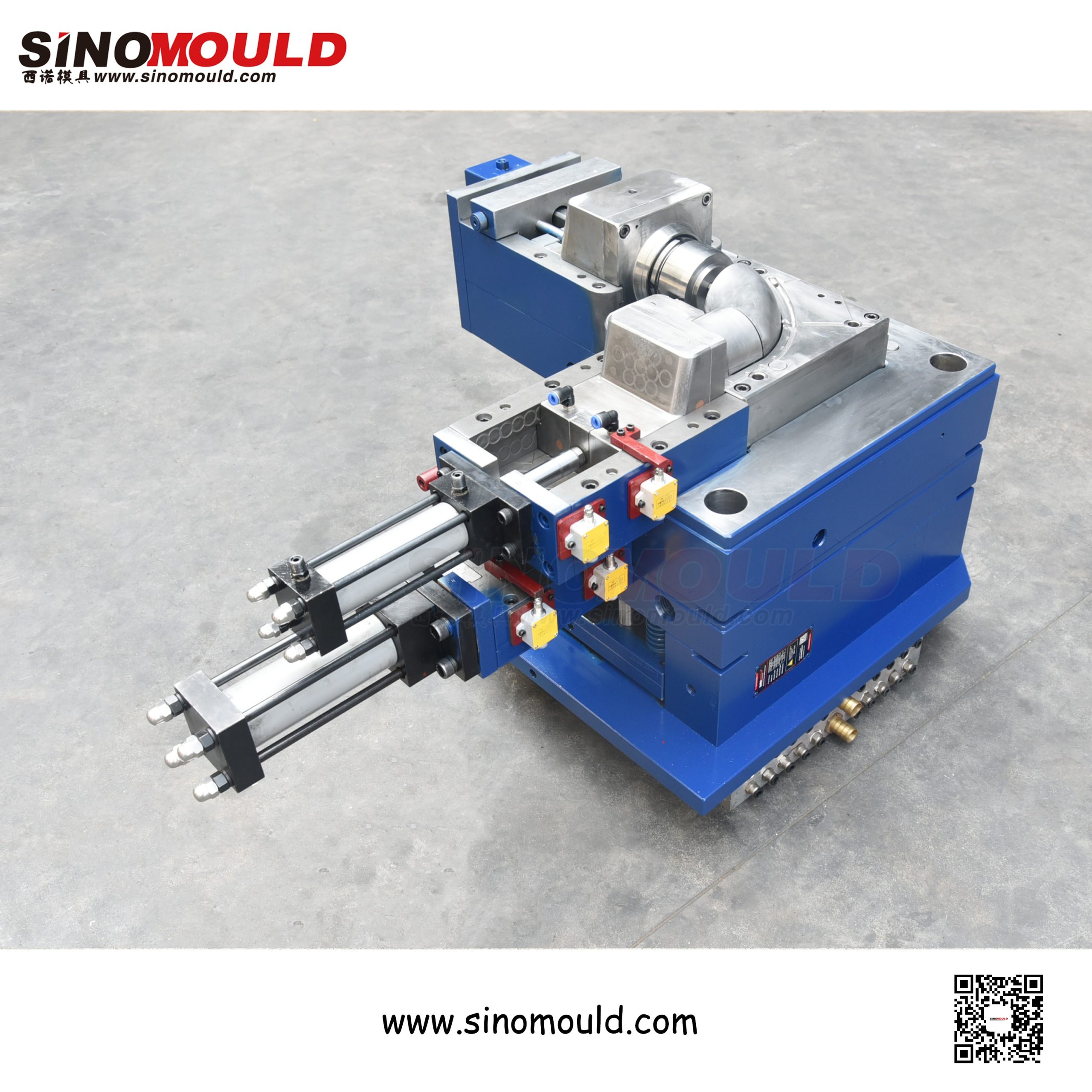
| Mould Base Standard / Steel | LKM Standard / S50C, S45C | Ejection System | Hydraulic motor + rack-and-pinion core pulling, ejector pin assist |
| Sliders, Inserts, Lifters Steel | High-strength tool steel, nitrided | Injection Process | Precision injection, mould temperature control ±2°C |
| Number of Cavities | 1×1 (recommended), 1×2 | Injection Cycle Time | 35–70 seconds |
| Hot Runner System | Hot runner + localised cold runner (PVC-specific) | Mould Manufacturing Lead Time | 45–70 days |
PVC 90° Elbow Pipe Mould Quality Control Points
- Perpendicularity of Socket Ends
The socket axes at both ends of a 90° elbow must be strictly perpendicular. A perpendicularity deviation exceeding 0.1mm causes stress concentration during assembly or rubber-ring seal failure. Through single-setup machining of cavity and core plus full CMM inspection, we hold the perpendicularity of the two axes within 0.08mm.
- Bore Roundness & Scratch Prevention
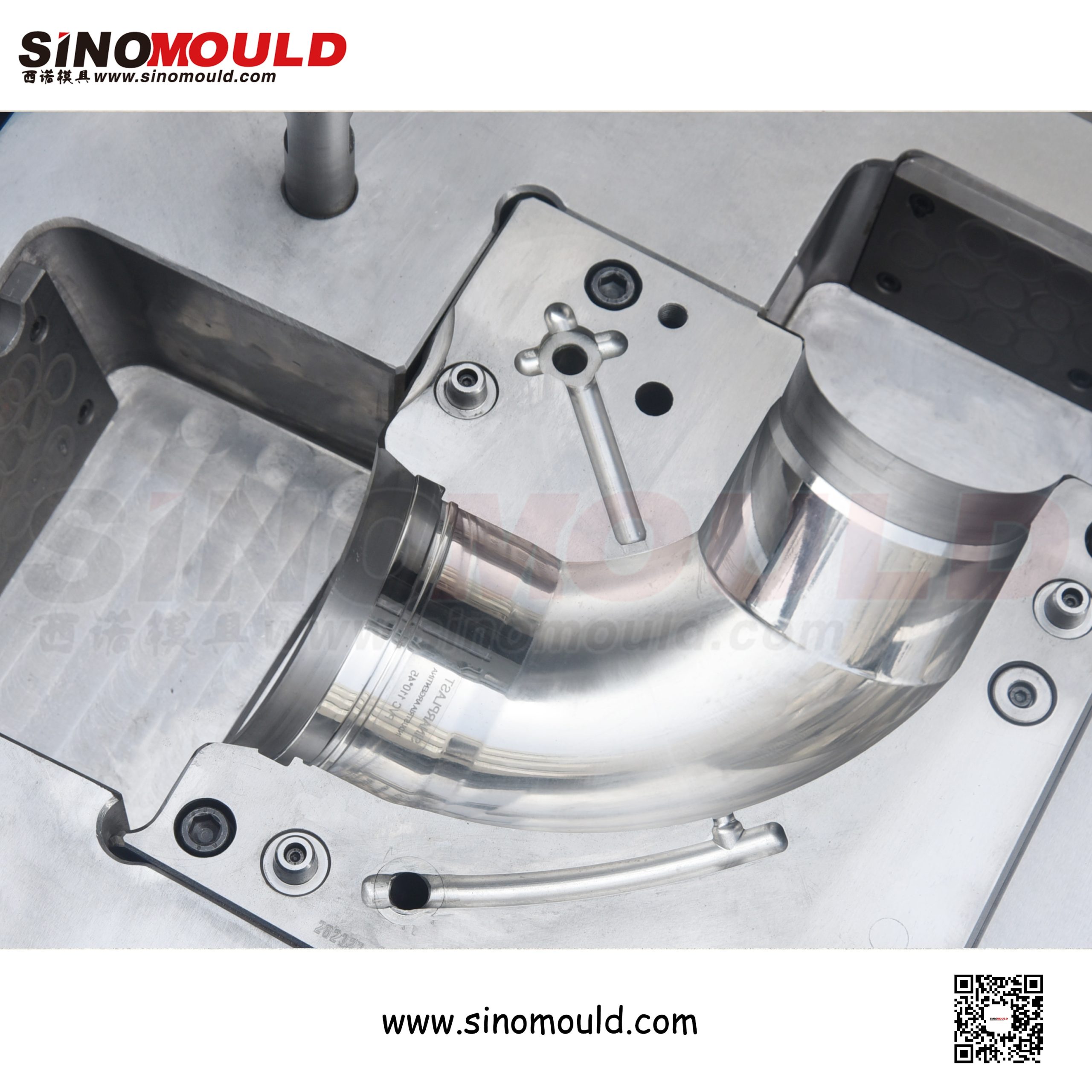
The 90° curved core has a long friction path against the bore during withdrawal; trajectory deviation or surface roughness can easily scratch the bore or cause ovalisation. The curved core surface is polished to Ra ≤ 0.4μm, and the guide structure keeps the withdrawal trajectory concentric with the arc, holding bore roundness within 0.1mm for smooth flow and intact sealing surfaces.
- Wall Thickness Uniformity for Large Diameter
At 100mm diameter, the thicker wall sections are prone to local sinking or dimensional drift from uneven cooling shrinkage. Cavity-to-core matching clearance is controlled to ±0.05mm, supported by mould flow analysis to optimise the packing profile, ensuring uniform wall thickness and consistent socket inner diameters.
- Socket Inner Diameter & Taper Consistency
Both sockets must interchange with same-spec pipes and fittings. We machine both core ends from a unified datum, holding inner diameter deviation within ±0.02mm and taper to customer standard, ensuring stable insertion depth and cement gap.
- PVC Thermal Stability & Cavity Corrosion Protection
PVC degrades at elevated temperatures, releasing hydrogen chloride that corrodes cavities and affects part appearance. The mould uses a localised cold runner at the hot runner tip to prevent material dwell; cavity steels are corrosion-resistant grades such as 1.2316 or S136, ensuring no rust or material build-up over long production runs.
PVC 90° Elbow Pipe Mould Manufacturing Highlights
- Staged Core Withdrawal for 90° Curved Core
The withdrawal stroke for a 90° elbow is long, making a one-piece curved core difficult to extract directly. We use a staged design: the straight core section withdraws axially first, then the curved core rotates out along the 90° arc. Both motions are precisely controlled by a hydraulic motor and rack-and-pinion mechanism, avoiding interference and scratching.
- Curved Core Trajectory Machining & Guidance
The curved core’s arc profile and rotation centre must be strictly concentric; otherwise, wobble occurs during withdrawal. We machine the curved core surface on five-axis CNC and the rotational guide slots by wire EDM, with trajectory tolerance ≤ ±0.02mm, ensuring smooth withdrawal and no eccentric wear on the bore.
- Multi-Point Gating & Thick-Wall Feeding
At 100mm, the elbow has thicker walls, and a single gate cannot adequately feed both socket ends. We arrange multi-point valve gates on the outer arc back and near both sockets, with sequential control to ensure sufficient packing in thick sections, avoiding voids and sink marks.
- Large-Diameter Cooling & Conformal Circuits
Heat concentrates at the arc back and socket walls, where uneven cooling causes deformation. We arrange conformal cooling circuits in the arc back region and embed beryllium copper inserts at thick socket walls to accelerate heat dissipation, equalising temperature across the part, shortening the cycle, and reducing internal stress.
- Mould Rigidity & Core-Pulling Guidance
The 90° core-pulling mechanism has many moving parts; insufficient mould rigidity causes core wobble and misalignment during closing. We thicken the mould base plates, locate core-pulling slides with wear plates and locking tapers, and use multiple precision guide posts and bushings (clearance ≤ 0.01mm) to ensure stable long-term operation.
- Trial Moulding & Validation
Every mould is trial-run continuously in our in-house injection workshop under simulated production conditions. Perpendicularity of both ends, bore roundness, socket dimensions, and core-pulling reliability are inspected. Only after passing these checks is the mould shipped.