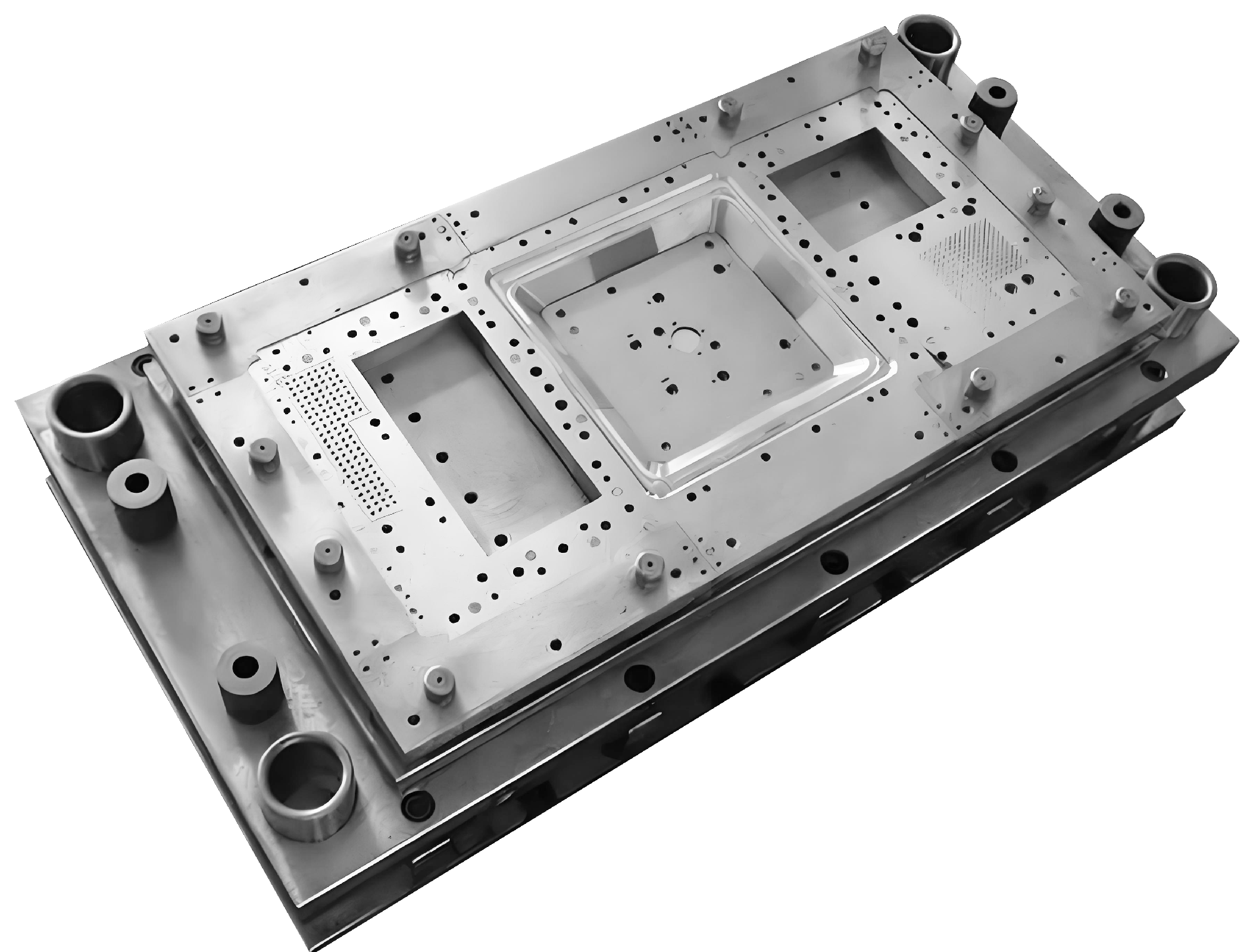
Microwave Oven Mould
SINOMOULD focuses on and deeply cultivates the household appliance mould field, specializing in the production of Microwave Oven Mould and microwave electric oven moulds. It provides one-stop mould solutions for household appliance manufacturing enterprises, helping them improve product quality and production efficiency.
Relying on a mature mould R&D and production system, equipped with a professional team of engineers and high-precision processing equipment, we strictly follow the quality control process. From mould design, mould opening, processing to inspection and delivery, we implement refined control throughout the whole process. We can provide customized services according to customer needs to adapt to the production of household appliance products of different specifications and models. We always take high quality and cost-effectiveness as the core, and rely on solid production strength and perfect services to provide reliable mould support for household appliance manufacturing enterprises, helping them enhance their core competitiveness.
We are committed to supplying our high-standard microwave oven moulds to both the domestic market and the Asian microwave oven mould market, leveraging our mature supply chain and professional technical support to provide comprehensive, one-stop mould solutions for manufacturers of all sizes, helping them optimize production processes and enhance market competitiveness.
Microwave Oven Mould Parameter
Mould Name: | Microwave oven shell Mould | Plastic Matrerial | ABS |
Mould Cavity: | 1 cavity
| Mould cavity Material: | 718H
|
Suitable Machine: | DKM350SV–DKM450sv
| Mould core Material:
| 718H
|
Delivery Time: | 75 working days | Mould Injection System: | Hot runner with pin point gate |
Processing Requirements and Technical Requirements of Microwave Oven Moulds
Microwave oven moulds, especially those for integral outer casings, are key equipment in household appliance manufacturing, requiring strict processing standards to ensure product quality, mould service life and production efficiency. Combined with industry practical experience, the core processing requirements are as follows:
01
Mold design and splitting must be scientific and reasonable. The mould splitting surface should be designed according to the structure of microwave oven plastic parts (such as outer casings, door panels, control panels), ensuring tight fitting with a fit gap of 0.01-0.02mm to avoid flash and material leakage during injection moulding. For large parts such as integral outer casings, one mould and one cavity are preferred to ensure moulding precision; for small parts such as foot pads and buckles, multi-cavity moulds can be adopted to improve production efficiency.
02
The processing precision of mould parts must meet the standard. The overall processing tolerance of the mould should be controlled within ±0.02mm, and the core and cavity, which are key parts, need to be processed with high precision to ensure the size accuracy of the injected plastic parts. For parts with complex structures such as IML moulds for oven doors, the positioning groove and clamping mechanism of the label should be processed with high precision to avoid label displacement during injection moulding.
03
The surface treatment of the mould is crucial. For appearance parts such as outer casings and door panels, the cavity surface should be polished to #4000-#6000 to ensure the surface of the plastic parts is smooth and free of scratches, bright spots and other defects. For moulds used in harsh environments, surface chrome plating or nitriding treatment can be carried out to improve corrosion resistance and wear resistance. For IML mould cavities, anti-adhesive treatment is required to facilitate label picking and placing.
04
The assembly and debugging of the mould must be careful. All mould parts should be assembled in strict accordance with the design drawings, ensuring that the sliding parts (such as sliders and core-pulling mechanisms) move flexibly without jamming. After assembly, trial moulding should be carried out, and parameters such as mould temperature, injection speed and holding pressure should be adjusted according to the trial moulding effect to eliminate defects such as shrinkage marks, weld lines and warpage, and ensure that the mould can stably produce qualified products.
In conclusion, the processing and technical requirements of microwave oven moulds are the fundamental guarantee for producing high-quality, high-efficiency and durable mould products. From the scientific design and precision processing of moulds to the rational selection of materials, structural optimization and strict control of process parameters, every link is closely related to the final quality of microwave oven plastic parts, the service life of moulds and the economic benefits of production.
By strictly following the above processing standards and technical specifications, SINOMOULD can not only effectively avoid common moulding defects, improve production stability and reduce maintenance costs, but also better meet the diverse needs of household appliance enterprises for microwave oven moulds. In the increasingly competitive market, adhering to standardized production and continuous technical optimization will help enhance the core competitiveness of microwave oven mould products, and lay a solid foundation for the long-term development of mould manufacturing enterprises in the field of household appliance supporting services.