Blog
Compartmentalized Trash Can Lid Mould
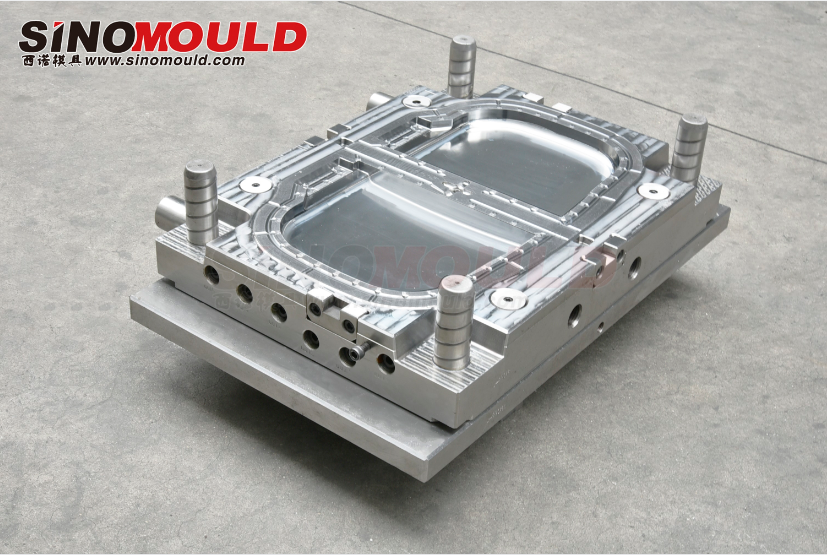
The compartmentalized trash can lid is a key component of modern waste sorting systems. Featuring a double- or multi-compartment structure joined to the bin body by a central hinge, this lid is widely used in household sorting bins and public recycling bins to separate dry/wet waste and recyclable/non-recyclable materials. Its flat, thin-walled cover surface with visible compartment dividers and hinge undercut demands precise mould design to ensure good appearance, proper closure and reliable hinge function.
The part’s large flat surface, thin walls and hinge undercut create specific moulding challenges: short shots in the compartment dividers, warpage across the large cover surface, and the need for slides or lifters to release the hinge undercut without marks. At SINOMOULD, we combine customised gating, conformal cooling and robust ejection designs to produce compartmentalized trash can lid moulds with stable dimensions and long service life. Below are the key specifications, quality priorities, and manufacturing essentials.
Standard Centrifuge Tube Mould Details
Below are examples of the most common parameters for compartmentalized trash can lid moulds.
| Compartmentalized Trash Can Lid Mould Cavity Steel | 718H/S136/NAK80 | Recommended Injection Machine | DKM Servo Energy Injection Molding Machine |
|---|---|---|---|
| Compartmentalized trash lid Mould Core Steel | 718H | Plastic Material | Medical-grade PP / HDPE |
| Mould Base Standard / Steel | 4Cr13 Pre-hardened Stainless Steel | Ejection System | stripper and ejector pins |
| Sliders, Inserts, Lifters Steel | High-strength tool steel with surface hardening treatment | Injection Process | Precision injection and temperature control |
| Number of Cavities | 1×2, two cavities | Injection Cycle Time | 40–45 seconds |
| Hot Runner System | Cold runner (hot runner optional) | Mould Manufacturing Lead Time | 45–70 days |
Key Quality Points of Compartmentalized Trash Can Lid Moulds
Compartment Dimension & Partition Accuracy.The compartment dividers are the core of the sorting function, so their position and height must be precise. Through matched machining of cavity and core, we hold compartment dimensions within ±0.2mm and keep partition walls uniform, ensuring consistent capacity across compartments and clearly identifiable sorting zones.
Hinge Undercut & Fit Accuracy.The lid connects to the bin body through a hinge and opens repeatedly, so the hinge undercut’s fit clearance directly affects opening force and service life. We form the hinge area with slides/lifters, controlling fit clearance within ±0.1mm to ensure smooth, wear-resistant rotation.
High-Gloss Surface Quality.The top surface of the lid is a visible surface, and must be free of sinks, flow marks, ejector witness or parting lines. The parting line is placed inside the cover edge, and the visible surface is polished to a mirror finish with surface roughness Ra ≤ 0.2μm, ensuring a smooth, attractive appearance.
Warpage Control for Large Flat Lids.The lid is a large flat thin-walled part, prone to warpage from uneven cooling, which causes poor closure with the bin body. We use conformal cooling circuits with zoned temperature control and balanced gating, holding flatness within 0.5mm to keep the lid straight and tightly sealed.
Material Environmental & Weather Resistance.Compartmentalized bin lids are exposed to indoor and outdoor environments for long periods, requiring non-toxic, weather- and ageing-resistant materials. The products use food-grade PP or HDPE, and the mould runner and gate design ensure stable filling without degradation, producing uniform colour, impact resistance and UV resistance.
Precision Machining Highlights for Compartmentalized Trash Can Lid Mould
Precision Machining of Cavity & Core.The lid is relatively large with compartment dividers, so both cavity and core are medium-to-large components. We use gantry CNC precision milling combined with wire EDM, holding critical compartment and hinge tolerances within ±0.02mm and surface roughness Ra ≤ 0.2μm.
Conformal Cooling Circuit Design.To control warpage across the large lid surface and shorten the cycle, we arrange multiple independently controlled conformal water circuits along the cover, with intensified cooling at the heat-concentrated hinge and divider areas, ensuring uniform temperature and consistent part dimensions.
Balanced Gating & Filling Design.Filling around the compartment dividers is complex, and a single gate can cause short shots in far dividers. We optimise gate location and number based on the part geometry, using multi-point gating with sequential control to advance the melt front steadily, avoiding weld lines and short shots.
Slide & Lifter Demoulding Mechanism.The hinge undercut cannot be demoulded directly and requires slides or lifters. We arrange reliable actuation mechanisms according to the undercut direction, with slides made of 718H and nitrided, guided by precision rails for stable, scratch-free core pulling and intact undercuts.
Ejector Plate Demoulding Design.Large flat thin-walled lids are prone to ejector witness and deformation during ejection. We use a combined ejector plate and evenly distributed pins along the cover edge and hinge ribs, ensuring balanced force and smooth, mark-free demoulding on the visible surface.
Trial Moulding & Validation.Every mould is trial-run continuously in our in-house injection workshop under simulated production conditions. Compartment dimensions, flatness, surface quality, hinge opening/closing and demoulding reliability are inspected. Only after passing these checks is the mould shipped, ensuring stable production from the customer’s first run.