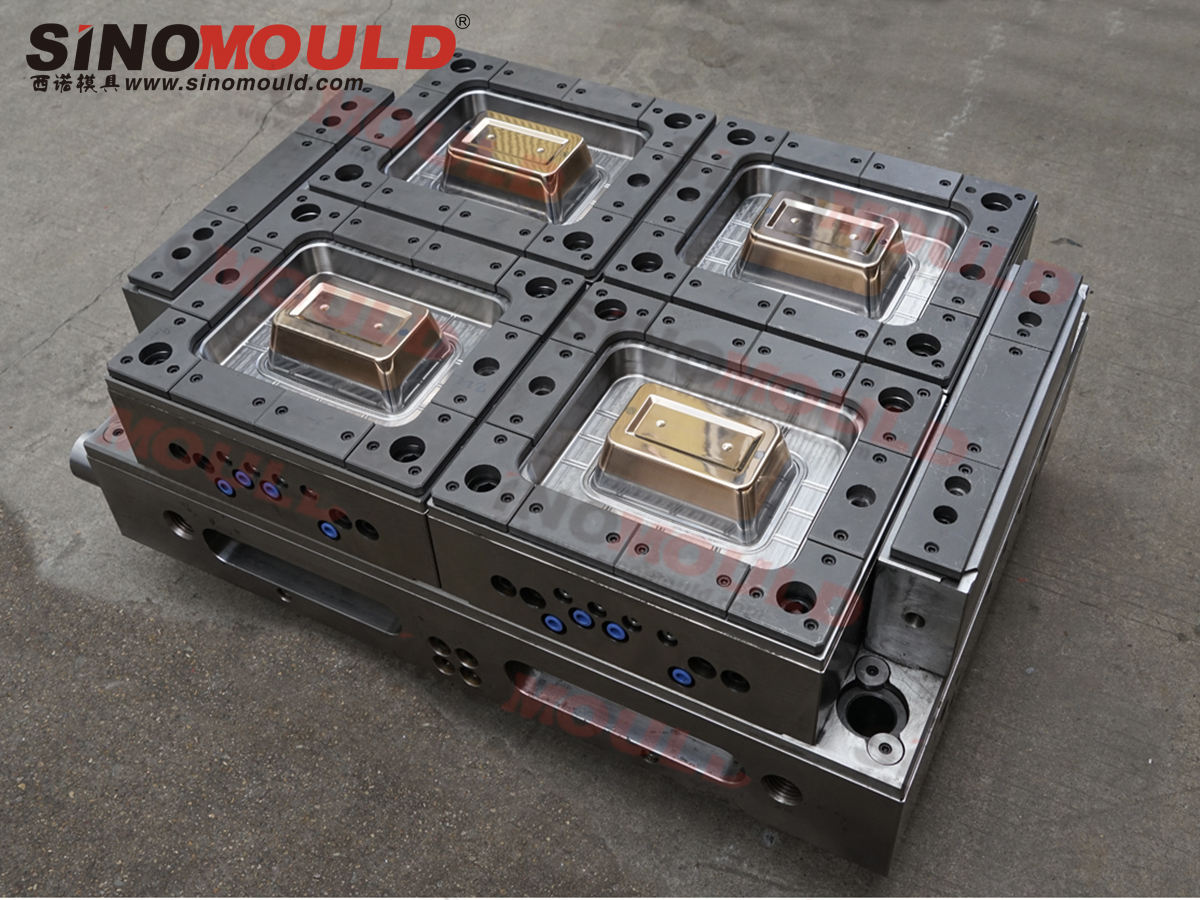
750ml Square Box Mould
The 750ml square box mould is a professional precision injection mold customized for 750ml square plastic container products, widely applicable to food packaging, daily storage, takeout catering and other fields. This square box mould adopts optimized square cavity structural design, with smooth product molding, uniform wall thickness and good stacking performance, which perfectly fits the mainstream 750ml square box market demand. Adopting high-quality mold steel and mature injection molding technology, the mould features stable operation, low failure rate, long service life and high production efficiency. It can produce transparent, frosted and colored 750ml square plastic boxes in batches, meeting the mass production and high-standard molding requirements of packaging box manufacturers.
Mould Detailed Parameters
Below are examples of the most common parameters for 750ml Square Box Mould.
| 750ML SQUARE BOX MOULD CAVITY STEEL | S136 MIRROR/2344 HARDENED | Recommended Injection Machine | DKM DFS SERIES HIGH SPEED INJJECTION MOULDING MACHINE |
|---|---|---|---|
| 500ml square Box Mould Core Steel | S136 Mirror/2344 Hardened | Plastic Material | Food-grade Pp |
| Mould Base Standard / Steel | LKM/HASCO/DME | Ejection System | Stripper+Air blow |
| Sliders, Inserts, Lifters Steel | Hardened steel | Injection Process | High-speed injection, short cycle time, precise temperature contro |
| Number of Cavities | 1-8 (custom) | Injection Cycle Time | 4-8 seconds |
| Hot Runner System | Valve gate | Mould Manufacturing Lead Time | 40–65 days |
Mould Quality Key Points
The quality of 750ml square box mould directly determines the yield and service life of plastic box products. We strictly control core quality standards in the whole production process.
First, steel material quality control. All mould steel materials are inspected before warehousing, with stable hardness, strong wear resistance and anti-rust performance, avoiding mould deformation, scratch and rust during long-term mass production.
Second, cavity precision control. The square cavity is processed with high-precision CNC equipment, with uniform cavity wall and accurate size, ensuring consistent 750ml capacity and regular square outline of finished products.
Third, structural stability inspection. Sliders, inserts and angle tops are tightly matched with no gaps, effectively preventing flash, burrs and deformation of square boxes during injection molding.
Fourth, cooling system optimization. Equipped with uniform circulating cooling water channels, the mould cools evenly, effectively reducing product shrinkage and improving product flatness.
Fifth, finished mould inspection. Strictly conduct multiple trial mold tests, check product molding effect, demolding smoothness and dimensional accuracy to ensure the mould meets mass production standards.
Mould Processing Key Points
In the processing and production of 750ml square box mould, we adopt refined processing technology to ensure mould precision and stability, with core processing points as follows.
- Rough machining precision control: Carry out integral rough machining of mold base, cavity and core, reserve reasonable finishing allowance, ensure balanced overall stress of the mould, and avoid subsequent processing deformation. Optimize the processing procedure of square cavity to ensure the verticality and flatness of the cavity.
- Fine finishing treatment: Adopt high-speed finishing equipment for cavity and core finishing, with smooth surface after processing. The cavity is finely polished to meet the mirror surface demand of transparent square boxes, ensuring no scratches or lines on the product surface.
- Precision matching processing: Precisely process sliders, inserts and demolding structures, control the matching gap within the standard range, ensure flexible movement of demolding mechanism, no jamming, and realize efficient and smooth demolding of products.
Heat treatment process: Conduct professional quenching and tempering heat treatment on key mould parts to improve steel hardness and toughness, enhance mould wear resistance and fatigue resistance, and greatly extend mould service life.
Assembly and debugging: Assemble all parts in strict accordance with the drawing standards, conduct repeated debugging and trial molding, adjust injection parameters and demolding stroke, and optimize the overall operation performance of the mould.