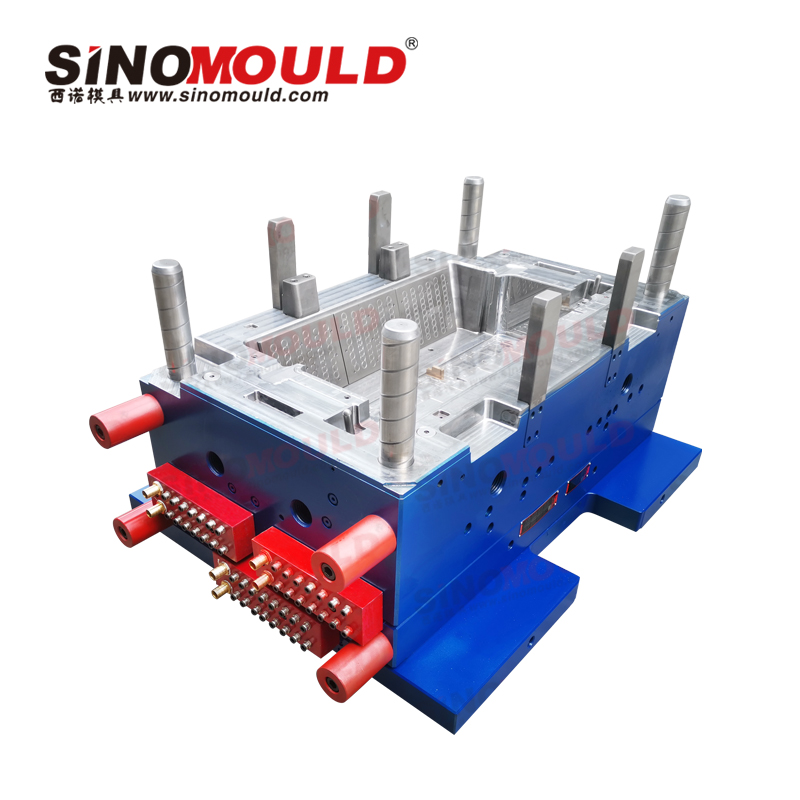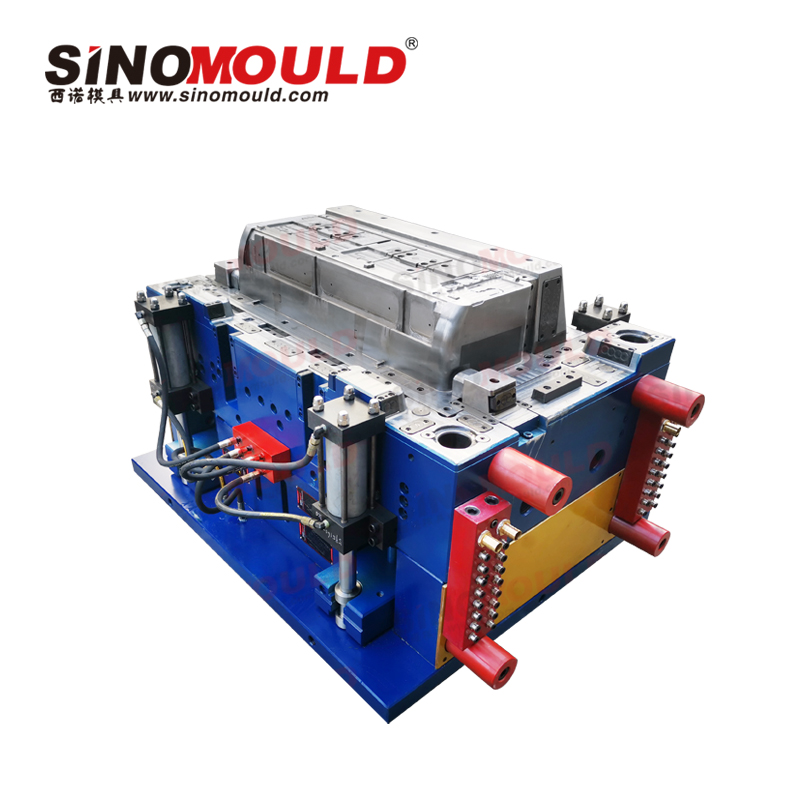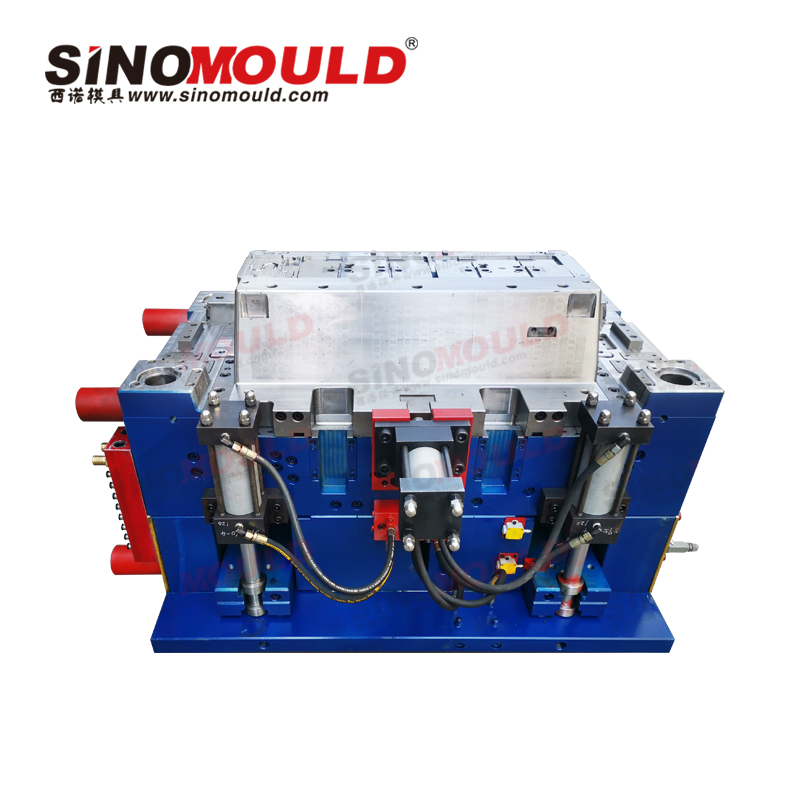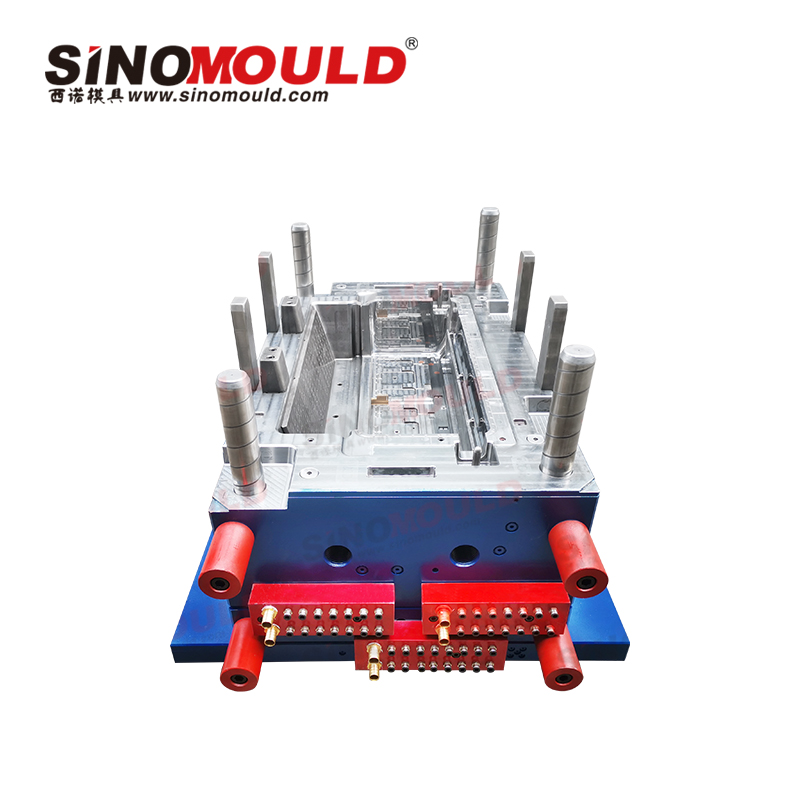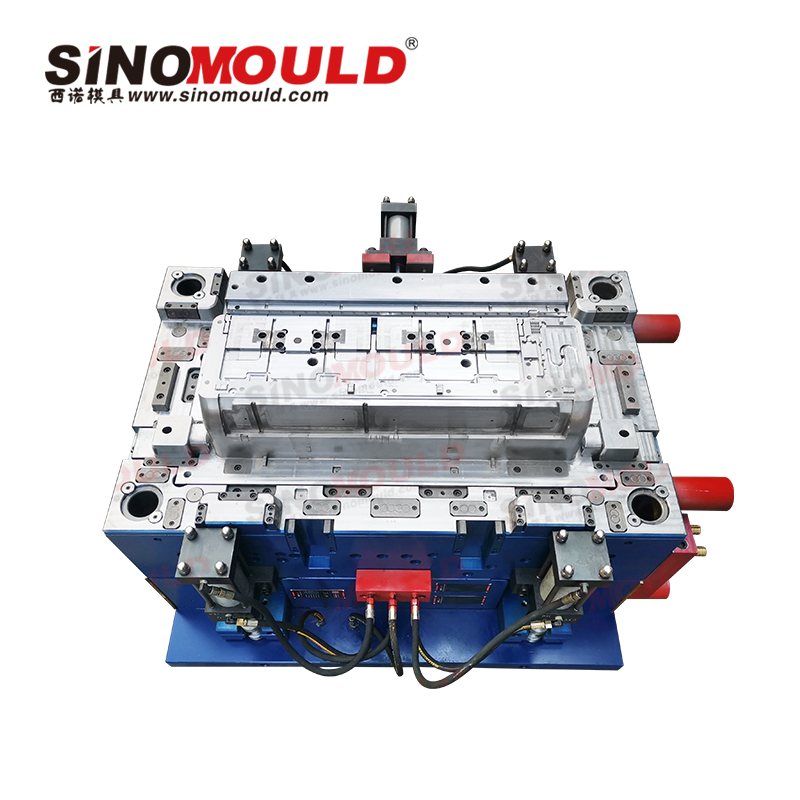
Air Conditioner Middle Frame Mould
The air conditioner middle frame is the core structural component of both wall-mounted and floor-standing AC units. It serves multiple functions, including securing internal assemblies, supporting the decorative panel, and directing airflow. It is one of the largest and most structurally complex plastic parts in an air conditioner. External dimensions can reach 843mm × 186mm × 301mm or larger, with a typical wall thickness of approximately 3.5mm. The complex structure requires multiple core-pulling mechanisms, placing extremely high demands on mould machining precision, structural stability, and demoulding reliability.
With deep expertise in the field of large precision moulds for home appliances, our company specializes in the design and manufacturing of large precision injection moulds for air conditioner middle frames. Through mould flow analysis optimisation, high-precision large-scale CNC machining, and a strict quality control system, we provide customers with full-process services from product design optimisation to mould delivery – ensuring excellent appearance, precise dimensions, and stable structure. The following is a comprehensive introduction from three perspectives: mould specifications, quality control, and machining essentials.
Air Conditioner Middle Frame Mould Specifications
| Mould Cavity Steel | S136, NAK80, 718H, P20 | Recommended Injection Machine | 1350T–1800T large injection molding machine |
|---|---|---|---|
| Mould Core Steel | S136, NAK80, 718H, P20 | Raw Material MFI | ABS/PP/HIPS: 10–25 g/10min (220°C, 10kg) |
| Mould Base Standard / Steel | LKM standard / P20, 50C | Ejection System | Ejector pins + stripper plate + slide core‑pulling + angled lifter linkage |
| Sliders, Inserts, Lifters Steel | High‑strength tool steel, nitrided | Injection Process | Precision injection molding, mould temperature control ±2°C |
| Number of Cavities | 1 cavity | Injection Cycle Time | 55–70 seconds |
| Hot Runner System | Valve‑gated hot runner / sequential valve control | Mould Manufacturing Lead Time | 35–70 days |
Supplementary Notes:
- Mould Dimensions and Weight: Large air conditioner middle frame moulds can reach external dimensions of 950mm × 1450mm × 1050mm, with mould weight exceeding 8000 kg.
- Modular Structure: The moving mould unit adopts a modular design with multiple inserts, facilitating manufacturing and later repair/disassembly.
- Mould Service Life: 500,000 – 1,000,000 cycles.
Air Conditioner Middle Frame Mould Quality Control Essentials
- Surface Quality Requirements
As a visible part of the air conditioner, the middle frame has extremely high surface quality requirements. The mould cavity surface must be precision‑polished or textured to ensure a smooth, flow‑mark‑free, sink‑mark‑free, and flash‑free product surface, meeting home appliance appearance standards.
- Dimensional Accuracy Control
The air conditioner middle frame has large external dimensions and complex structure. Critical mating dimensions must be controlled within ±0.03 mm. Full dimensional inspection must be performed using high‑precision equipment such as bridge‑type CMM and articulated arm measuring machines to ensure dimensional consistency across all assembly points, meeting final product assembly requirements.
- Mould Structural Stability
Large moulds, due to their size and the weight of the moving half, are prone to instability caused by floating of the moving half. Optimisation of the overall mould structure and proper arrangement of guiding and clamping mechanisms are required to ensure smooth and reliable operation during high‑speed injection.
- Strict Material and Process Control
Common materials for air conditioner middle frames include ABS, PP, and HIPS. Strict control of material drying processes and MFI is required to ensure stable melt flowability. Injection process parameters must be optimised through mould flow analysis to avoid surface defects such as sink marks.
- Mould Trial Verification
Mass‑production simulation mould trials are conducted in our in‑house large injection workshop using the same process conditions as actual production – verifying mould stability and product yield. Delivery is only approved after a successful first trial.
Air Conditioner Middle Frame Mould Machining Essentials
- Large Mould Precision Machining
Air conditioner middle frame moulds are large in size and require high machining precision. Large gantry high‑speed CNC machines, large precision EDM, and wire EDM are required to ensure cavity and core machining accuracy within 2 μm. The cavity surface must be precision‑polished to ensure product appearance finish.
- Runner System Design
Large middle frame products have long filling paths. A valve‑gated hot runner or sequential valve hot runner system is recommended. By precisely controlling the opening and closing sequence of multiple gates, balanced melt filling is guided, effectively eliminating weld lines and improving product appearance quality. Hot runner systems can shorten the injection cycle by 20‑30%.
- Cooling System Optimisation
Cooling uniformity of large moulds directly affects product dimensional stability and internal stress control. Multi‑layer annular cooling channels or conformal cooling systems should be designed, with zoned independent mould temperature control maintaining temperature variation within ±2°C – ensuring consistent cooling rates across all areas, effectively shortening cooling time and reducing product warpage.
- Core‑Pulling and Demoulding Mechanism Design
The complex structure of the air conditioner middle frame requires multiple slide core‑pulling and angled lifter mechanisms. An integrated slide assembly design can be adopted, with angled lifters linked to the front of the slide core‑pulling unit. The hydraulic cylinder first moves the slide laterally for demoulding; after reaching a certain stroke, the positioning assembly moves together with the slide to achieve full demoulding. Hidden core‑pulling mechanisms use inclined guide slots to convert horizontal motion into angled core‑pulling motion, with ejector pins added on hidden core‑pulling inserts to prevent product damage during core‑pulling.
- Modular Structural Design
A modular design for the moving mould unit divides it into multiple inserts – simplifying machining and manufacturing, and facilitating later maintenance and insert replacement. Core and cavity insert technologies are used, balancing structural feasibility with sufficient strength.
- Venting System Design
Large middle frame products have extensive filling areas and long gas evacuation paths. An efficient venting system must be designed at the parting line and deep‑cavity areas to prevent gas traps that cause burning or short shots, ensuring stable and reliable injection.
- Machining Equipment Assurance
Critical components are machined using high‑precision equipment such as large CNC machining centres, gantry CNC engraving machines, and twin‑head EDM. Full dimensional inspection using CMM ensures mould fit accuracy and long service life.