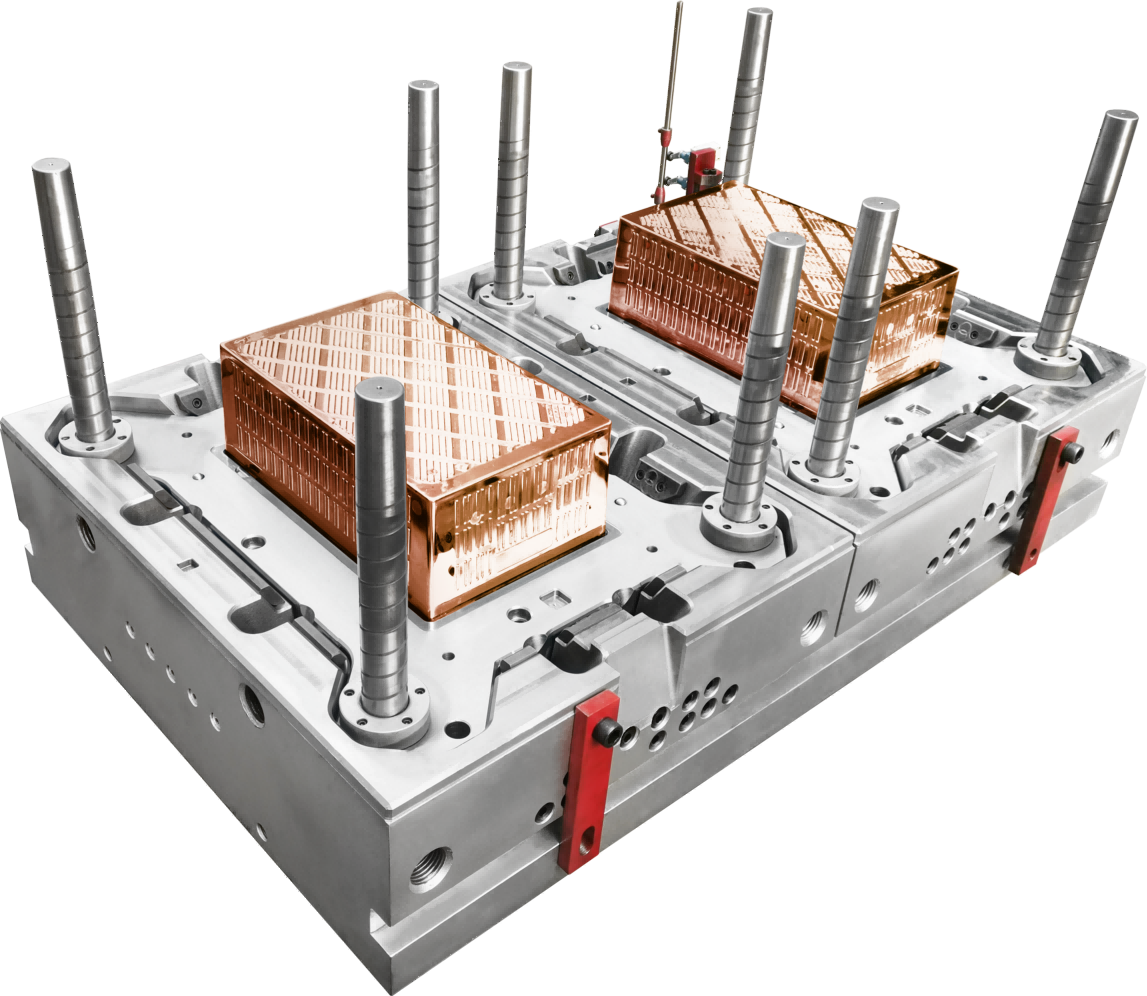
Bakery Crate Mould (Bread & Cake Crate Mould)
SINOMOULD has specifically developed bakery crate moulds for the food baking and cold‑chain distribution industry.
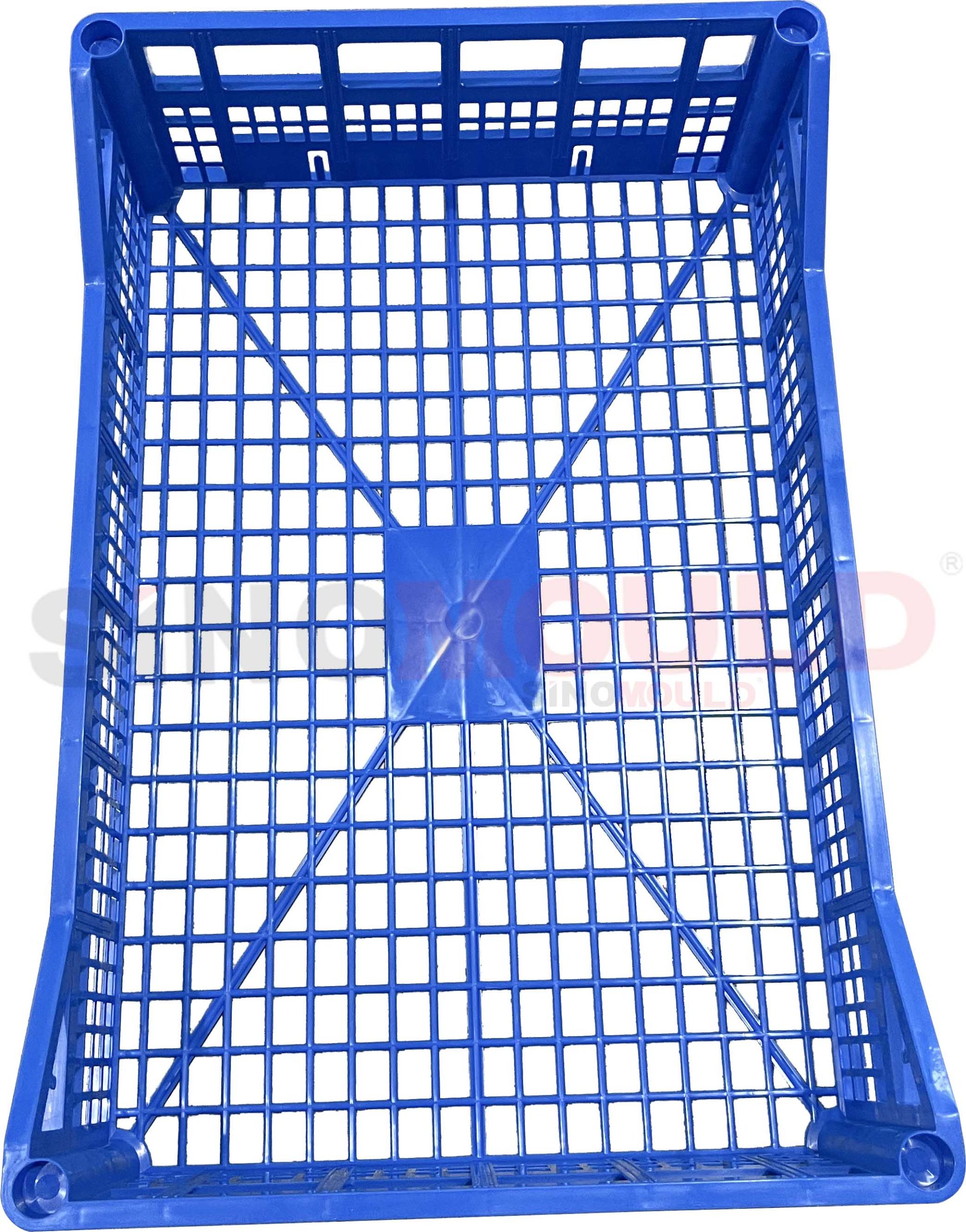
Bakery crates typically feature complex ventilation grids and anti‑collision partitions to protect delicate products such as bread and cake during stacked transport. In the development of cake crate moulds and bread crate moulds, SINOMOULD focuses on controlling flatness of large thin‑wall surfaces, designing rounded, non‑sharp contact areas, and establishing process windows for low‑temperature impact‑resistant HDPE/PP materials.
Our delivered moulds offer highly competitive cycle times, optimized runner designs for anti‑stacking adhesion and easy cleaning, making SINOMOULD the preferred mould supplier for large bakery chains and food industrial packaging manufacturers.
Bakery Crate Mould Specifications
SINOMOULD customizes moulds for standard bakery crates. The following parameters are optimized according to the number of stacking layers (typically 2‑3 layers) and ventilation pattern design:
| Applicable Product | Standard 600mm × 400mm shallow tray or nested multi‑layer stacking crate | Product Features | Large non‑slip bottom, rounded ventilation grids, ergonomic handles, obstruction‑free stacking grooves |
|---|---|---|---|
| Number of Cavities | 1 cavity (large shallow‑tray body) or 2 cavities (small cake box base) | Mould Overall Dimensions | Fully customized based on product projected area and cavity number |
| Compatible Injection Machine Tonnage | 1200T – 2000T (calculated according to large flat surface area and cavity depth) | Main Mould Steel | 718H / 2738H (high polishability, corrosion resistance, suitable for food‑grade production) |
| Injection System | Valve‑gated timed‑sequence hot runner (no gate residue, no weld lines on large flat surfaces) | Ejection System | Large‑area flat ejectors + straight ejector blocks + auxiliary air blow combined ejection |
| Cycle Time | 15–20 seconds | Mould Design Life | Over 1 million cycles (reinforced mould base for long‑term high‑frequency operation) |
| Standard Delivery Time | 60 working days | Core Process Features | Large‑surface anti‑warpage control, rounded stress‑free design, easy‑clean mirror finish |
Bakery Crate Mould Quality Essentials
Because bakery crates come into direct contact or close storage with food, SINOMOULD has established quality standards stricter than general crates in terms of food‑grade cleanliness, scratch resistance, and smooth stacking:
- Large‑surface rigid anti‑warpage & food‑contact design
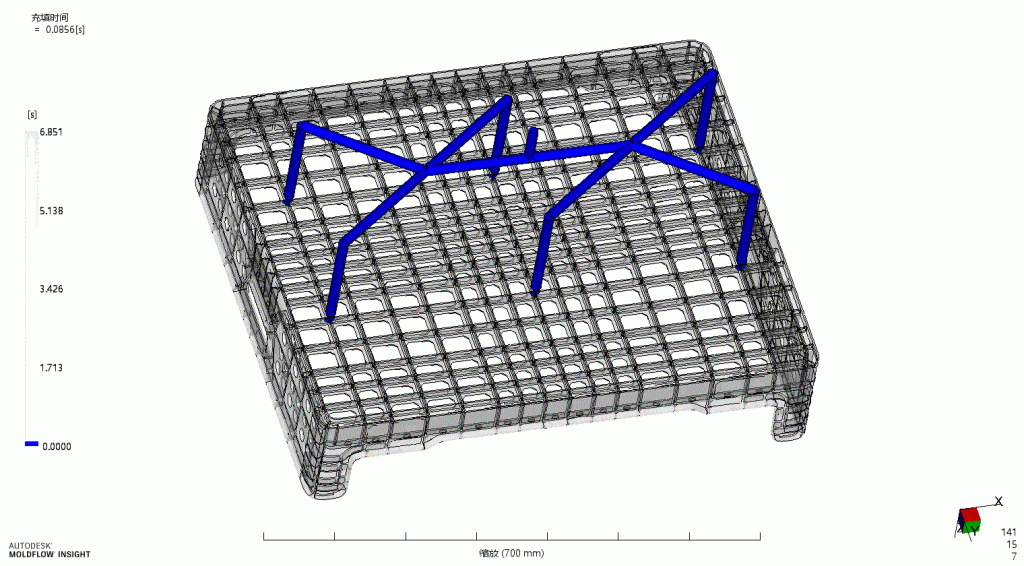
The large flat bottom of a cake crate is prone to local concave warpage after demoulding. SINOMOULD uses multi‑rib reinforcement on the back of the cavity and applies pre‑deformation compensation for large flat shrinkage based on Mouldflow analysis. At the same time, all moulding surfaces on the product are designed with rounded transitions, eliminating any sharp burrs from the mould, ensuring a smooth finished surface that will not scratch soft bread crusts or trap food residues.
- Anti‑stacking adhesion & precise clearance control
Bakery crates are often stacked for storage or transport. Insufficient draft or uneven shrinkage can cause jamming. We perform laser interference scanning on male/female stacking features and optimize the demoulding draft angle to 3°–5° based on tribology. This ensures smooth automatic stacking and destacking with high frequency, eliminating jamming and bottom‑drop risks.
- Flash‑free ventilation grid forming & balanced ejection verification
The sides of a crate are often covered with dense ventilation holes or patterns. SINOMOULD uses tapered four‑side precision interlocking and micro‑venting steel inserts. While ensuring full and open grid formation, cavity gas is instantly expelled through the venting system, eliminating flash at the grid roots. During ejection, distributed flat ejectors ensure zero stress concentration on the wall, preventing local whitening or puncture.
- HDPE toughness & residual stress relief for cold‑chain tolerance
For the baking cold‑chain environment (down to -20°C) and frequent forklift impact, our moulds use extended cooling/holding settings and a dynamic mould temperature balance system to fully release HDPE residual stress. Crates produced with this process will not become brittle or crack in low‑temperature drop tests, significantly extending impact resistance service life in cold storage.
Bakery Crate Mould Machining Essentials
A high‑quality bakery crate mould demands excellent flatness on large surfaces and efficient removal of massive grid features. SINOMOULD’s manufacturing process includes:
- Large‑plane high‑speed, high‑precision gantry milling & in‑process inspection
For the flat cavity bottom of a cake crate, a large gantry high‑speed milling machine with precision toolpaths achieves a one‑step milled flatness of Ra ≤ 0.8μm. The machine is equipped with a Renishaw in‑process probe to monitor machining thickness in real time, ensuring flatness error below 0.05mm over a 600mm length—preparing the surface for polishing and easy food‑grade cleaning.
- CNC drilling & milling composite machining for ventilation grids
For thousands of side‑wall grid holes, we abandon inefficient EDM and instead use 5‑axis drilling & milling composite centers for simultaneous drilling and countersinking. This guarantees smooth R‑radius edges on every ventilation hole—aesthetically pleasing and stress‑concentration‑free. This method greatly shortens the manufacturing cycle while ensuring smooth demoulding.
- Dead‑zone‑free easy‑clean surface polishing & texturing
Food safety requires that no polishing dead zones exist on the mould cavity. SINOMOULD’s polishing team performs full‑area high‑gloss polishing (Ra ≤ 0.1μm) on all contact surfaces, eliminating micro‑pores that could trap food residues. For scratch‑hiding requirements, Mould‑Tech matte sandblasting can be applied—it not only looks premium but also effectively masks minor service scratches.
Mould Flow Analysis for Bakery Crate Moulds